sick_perception_sdk
The sick_perception_sdk is a C++17 library for receiving SICK LiDAR data, configuring sensors, and building diagnostic or recording applications. It provides event-driven, thread-safe data acquisition from multiple sensors, as well as ready-to-use examples.
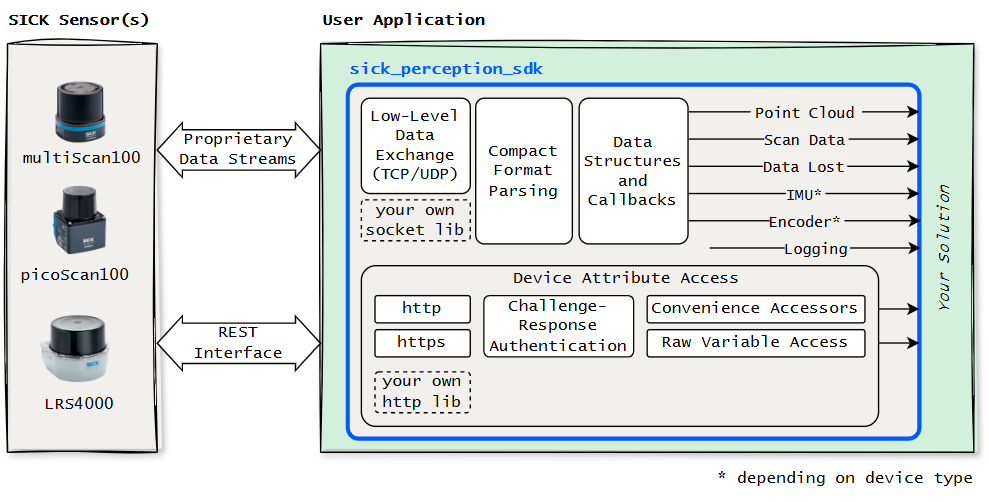
sick_perception_sdk data streaming, REST-based configuration, and additional tools.
Supported Devices and Platforms
The SDK supports these device variants:
Supported Devices and Platforms: product family and variants.
| Product family | Variants |
|---|---|
| LRS4000 | LRS4581 |
| multiScan100 | multiScan136, multiScan165, multiScan166 |
| multiScan200 | multiScan270 |
| picoScan100 | picoScan120, picoScan150 |
The SDK's example build option targets LRS4000, multiScan100, multiScan200, or
picoScan100.
The project builds with CMake on Linux and Windows and supports x86_64 and ARM64. Tested platforms are Ubuntu 22.04 LTS, Ubuntu 24.04 LTS, and Windows 11. macOS is not a tested platform.
Build and Integrate
The SDK uses CMake and Conan 2 is available for dependency management. Follow the upstream build instructions and CMake integration example for the current options and dependencies. The example build can be selected for a device family, and the CMake project exposes separate components for drivers, sensor configuration, and Compact format.
Receive and Record Data
The SDK receives event-driven scan, IMU, and encoder data using SICK's Compact
format over TCP or UDP. Scan data is exposed as point clouds (Public
PointField::DataType API).
The Compact-format layer provides a PointCloudToPCDConverter helper for
converting scan-derived point clouds to PCD for tools such as CloudCompare.
This is a conversion facility. The SDK does not provide a separate,
ready-made recording workflow. The sensor_configuration component
provides REST-based access to sensor settings and status.
Threading, Diagnostics, and Logging
Data acquisition is thread-safe and event-driven, including when acquiring from multiple sensors. The SDK includes diagnostic examples and built-in diagnostic and logging capabilities. The default logger uses plog; applications can provide a custom logger and set a minimum log level.
See the SDK README for current setup details, examples, and API documentation.